
The Task Force on Nature-related Financial Disclosures (TNFD) is an international organization established to develop a framework for corporate risk management and disclosure regarding natural capital and biodiversity. In September 2023, the TNFD published its final recommendations, which constitute the disclosure framework.
On this occasion, HAZAMA ANDO CORPORATION (“Hazama Ando”) (Headquarters: Minato-ku, Tokyo; President: Kazuhiko Kuniya) has decided to disclose information based on the TNFD recommendations going forward.
- 1. Application of Materiality
- The HAZAMA ANDO Group will identify materiality (material issues) by taking into account both the impact of the Group’s business activities on nature and the impact of changes in nature on the Group’s growth, and disclose information accordingly.
- 2. Scope of Disclosures
- The Group’s core business: Construction Business in Japan (the extraction of raw materials for key construction materials such as concrete, production of materials, and construction work)The basis for selection is as described in “3. Strategy: (1) Target Value Chain.”
- 3. Location of Nature-Related Issues
- Main construction sites for the Group’s Construction Business in Japan
- 4. Integration with Other Sustainability-Related Disclosures
- This disclosure is formulated in light of the previous disclosures on climate change based on the TCFD recommendations. Accordingly, we will consider implementing integrated disclosures going forward.
- 5. Time Horizons Considered
- Short term: Up to 3 years; Medium term: Over 3 years and up to 10 years, and; Long term: Over 10 years
- 6. Engagement with Indigenous Peoples, Local Communities and Affected Stakeholders
- As outlined in “1. Governance (2) Human rights policy and engagement with respect to affected stakeholders, including local communities”
1. Governance
(1)Framework
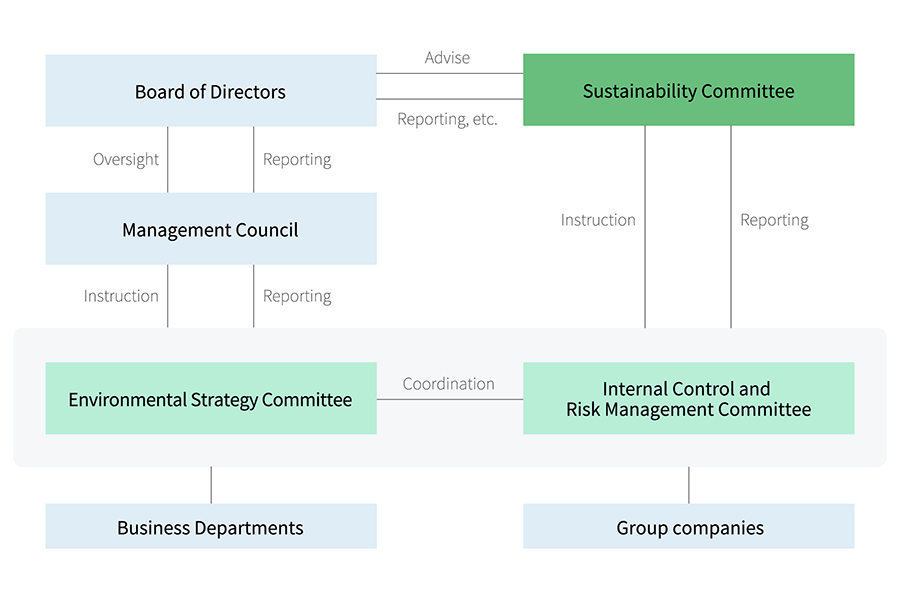
Dependencies, impacts, risks, and opportunities related to nature are deliberated by the Environmental Strategy Committee. The committee includes representatives from the business divisions and other executives. Members first identify the Group’s dependencies and impacts on the natural environment, as well as the risks and opportunities related to its growth. They then analyze the extent of the impact should these issues materialize and consider appropriate countermeasures. Results of deliberations are reported to the Board of Directors through the Management Committee.
The Internal Control and Risk Management Committee examines and deliberates on the management of risks that may significantly impact business. Their findings are reported to the Board of Directors after being discussed at the Sustainability Committee. Risks arising from impacts on nature are addressed in collaboration with the Environmental Strategy Committee.(Organizational Framework)
(2)Human rights policy and engagement with respect to affected stakeholders, including local communities
In its Human Rights Policy, the Group stipulates that it will take into consideration the impact of its business activities on local communities, including indigenous peoples, and strive to coexist with local communities while also engaging in dialogue and discussions with relevant stakeholders regarding the impact of its business activities on human rights and its response to human rights issues. In addition, under its Procurement Policy, the Group codifies its commitment to respect basic human rights and to contribute to local communities. By respecting human rights and communicating with local communities, which includes the supply chain, the Group is dedicated to coexisting with society as it engages in its business activities. For example, every effort is made to build relationships of trust with nearby residents through pre-construction briefings and other initiatives at each construction site.
2. Strategy
To identify our dependencies as well as impacts on nature, together with risks and opportunities associated with our growth, the Group conducted an analysis using the Locate, Evaluate, Assess, Prepare (LEAP) approach recommended by the TNFD.
Locate:Identify Points of Contact with Nature
(1)Target value chain
The HAZAMA ANDO Group’s target scope encompasses its Construction Business in Japan (the Civil Engineering and Building Construction businesses), which accounts for approximately 90% of total net sales. Referencing the tools put forward under the TNFD recommendations, the Group analyzed construction projects thought to interact significantly with nature, as well as the extraction of raw materials and the production of key construction materials. Downstream activities were excluded from the scope due to the scale of operations (activities such as the management, demolition, and disposal of buildings and structures by the group) and due to buildings and structures across diverse industries (activities such as their operation).

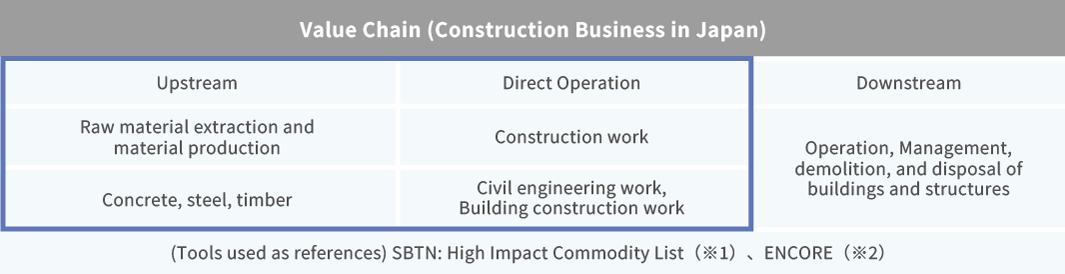
(※1) Science Based Targets Network (SBTN): A tool for assessing significant impacts on nature developed by an initiative that is developing guidance for setting nature-based science goals. Materials with a significant impact include cement and sand (raw materials for concrete), steel, and lumber.
(※2) A tool for identifying nature-related dependencies and impacts, developed by the United Nations Environment Programme, the World Conservation Monitoring Centre, and others. Analysis results are listed on the next page.
(2)Identification of priority locations
For 130 domestic construction sites of a certain scale or larger, the Group conducted an analysis, in accordance with the TNFD’s definition of sensitive locations, to identify project sites adjacent to nature in ecologically sensitive areas. The analysis considered proximity to areas critical for biodiversity, such as nature reserves, and areas where the natural state of ecosystems is preserved, as well as physical water risks. Specifically, we utilized the World Wide Fund for Nature (WWF) Biodiversity Risk Filter and Water Risk Filter recommended by the TNFD to identify construction sites where the risk assessment was rated “Very High (VH)” (score of 4.2 or higher) in any of the following categories (1) through (4).
① Areas important for biodiversity (nature reserves, etc.)
② Areas of high ecosystem integrity (areas largely untouched by human activity and in a natural state)
③ Areas of rapid declines in ecosystem integrity
④ Areas of high physical water risk (areas at high risk due to drought, flooding, water pollution, etc.)
For sites identified as sensitive locations, the Group prevents adverse impacts on nature by conducting environmental impact assessments, including biodiversity conservation, and identifying and managing environmental risk factors (setting targets, planning and implementing countermeasures, and conducting regular monitoring and improvements) based on its environmental management systems. Since construction sites are time-limited projects and are subject to turnover, plans are in place to identify and analyze sensitive locations once a year, in principle.

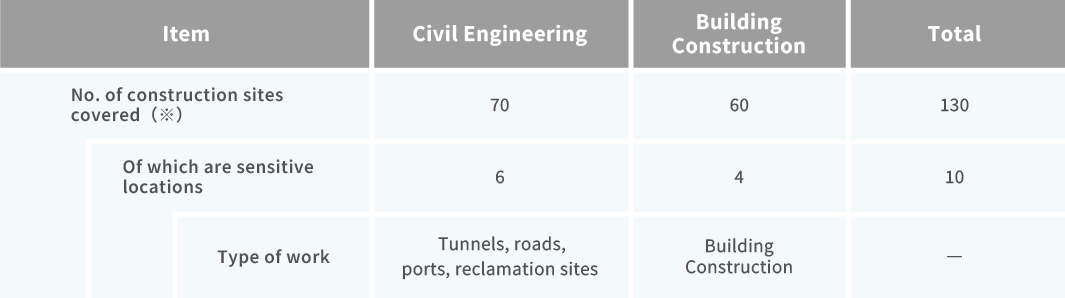
(※)Construction sites with a value of \1 billion or higher (excluding building renovation work, as of January 2026)
Meanwhile, priority locations have not been identified for the upstream portion of the value chain because locations have not been designated.
Evaluate:Identify and Evaluate Dependencies and Impacts on Nature
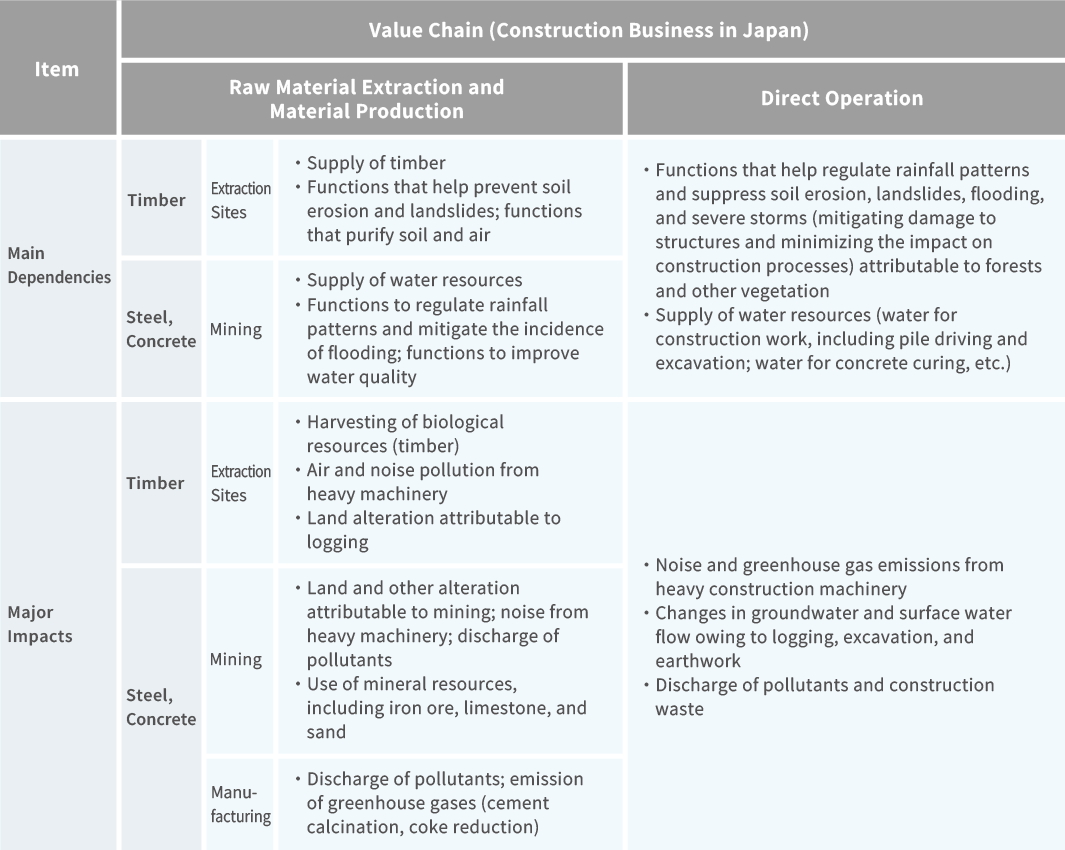
The results of analyses of the dependencies and impacts on nature with respect to the upstream portion of the value chain and direct operations, conducted using ENCORE, a TNFD-recommended tool, are as follows.
Turning to the upstream portion of the value chain, analyses revealed a high degree of dependence on ecosystem services and a significant impact on nature during the raw material extraction stage.
ENCORE Analysis Results

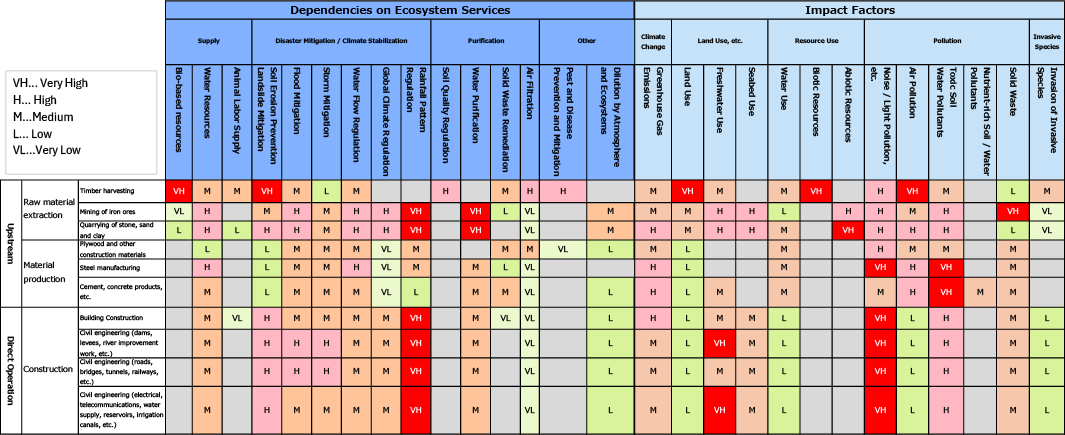
Based on the ENCORE results, the Company conducted an internal review of construction projects (tunnels, roads, etc.) in the priority areas identified during the Locate phase and has organized the key ecosystem services on which our business activities depend and the key factors affecting nature as follows.
Key Ecosystem Services on Which Business Activities Depend and Key Factors of Impacts of Business Activities on Nature

Assess:Identify and Evaluate Risks and Opportunities Related to Nature
(1)About scenarios
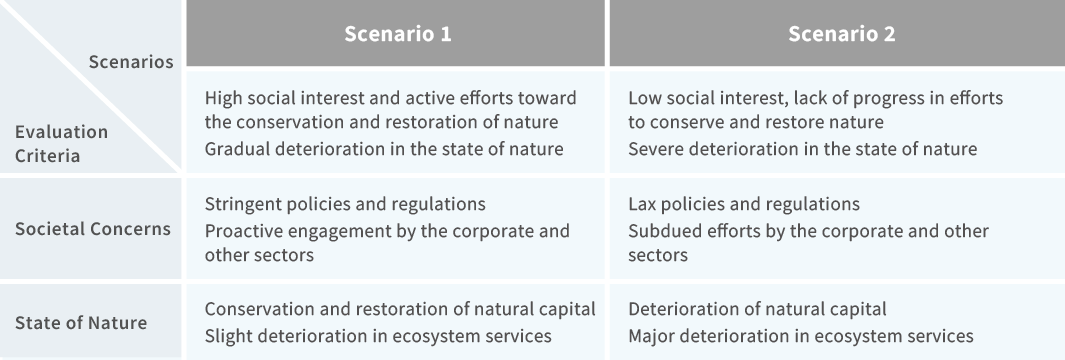
In analyzing risks and opportunities, the Company established two scenarios based on the degree to which transition risks (societal concerns) and physical risks (the state of nature), as recommended by the TNFD, materialize.
Societal concerns: Regulations and policies related to nature conservation and restoration, as well as the approach taken by companies, investors, and other stakeholders
State of nature: The degree to which the loss of natural capital and deterioration in ecosystem services materialize

(2)Identification and evaluation of risks and opportunities
The Group identified risks and opportunities based on its dependence and impact on nature, as well as external factors for each scenario (level of societal concern and state of nature). Steps were then taken to evaluate the identified risks and opportunities using the two-axis framework of magnitude of impact and likelihood of occurrence, after which the Group selected the following as key risks and opportunities. In addition to risks and opportunities related to climate change, the Group recognizes the growing demand for projects that take biodiversity into account, such as greening initiatives, as ecosystem-related opportunities.
Disclosure of climate-related financial information based on the TCFD recommendations is as follows. Recognizing that climate change and biodiversity are interrelated issues, the Group will consider disclosing information on an integrated basis.
Prepare:Disclose Details of the Group’s Initiatives
Initiatives related to biodiversity conservation are as follows.
-
Ikimono Plus, a tool that supports the development of planting plans that take native species into account during the design phase
-
Ikimono Info, a biodiversity-related database
-
Environmental Information GIS, an online platform that allows users to share information on flora and fauna with project areas
-
UUell, a green space design support system that assists architects with landscaping plans
Details (In Japanese only)
Technology to conserve ecosystems
-
Demonstration field at the Group’s Technical Research Institute (landscaping that takes into consideration neighboring wildlife, etc.)
Landscaping technologies
-
Hot water weeding and the use of plant allelopathy to reduce environmental impact
IPM management (comprehensive pest and weed management)
-
The Technical Research Institute acquires ABINC certification
Environmental certification acquisition
-
Examples of endangered animal conservation at construction sites, etc.
Expansion into the Construction Business
Participation in the 30 by 30 alliance
-
Acquired EPD (Environmental Product Declaration)
Environmental impact evaluation in compliance with international standards
3. Risk and Impact Management
The Group’s Environmental Strategy Committee identifies nature-related dependencies, impacts, risks, and opportunities. With its value chain in mind, the Group assesses the impact on the Group as a whole, the potential financial impacts of each project under various scenarios, and comprehensively evaluates the significance of risks and opportunities based on the criteria of magnitude of impact and likelihood of occurrence.
With respect to the significant risks identified, the Group engages in Group-wide risk management, primarily through the Environmental Strategy Committee and the Internal Control and Risk Management Committee, under the supervision of the Board of Directors and the Sustainability Committee. This includes the formulation of policies regarding risk avoidance, mitigation, transfer, and retention, as well as the development of countermeasures. The Group also monitor the implementation status and effectiveness of these countermeasures.
4. Metrics and Targets
The Group has established metrics based on the core global indicators recommended by the TNFD.